7 Jun 2026
Security Protocols Directing the Rollout of Advanced Capabilities in Digital Transfer Platforms

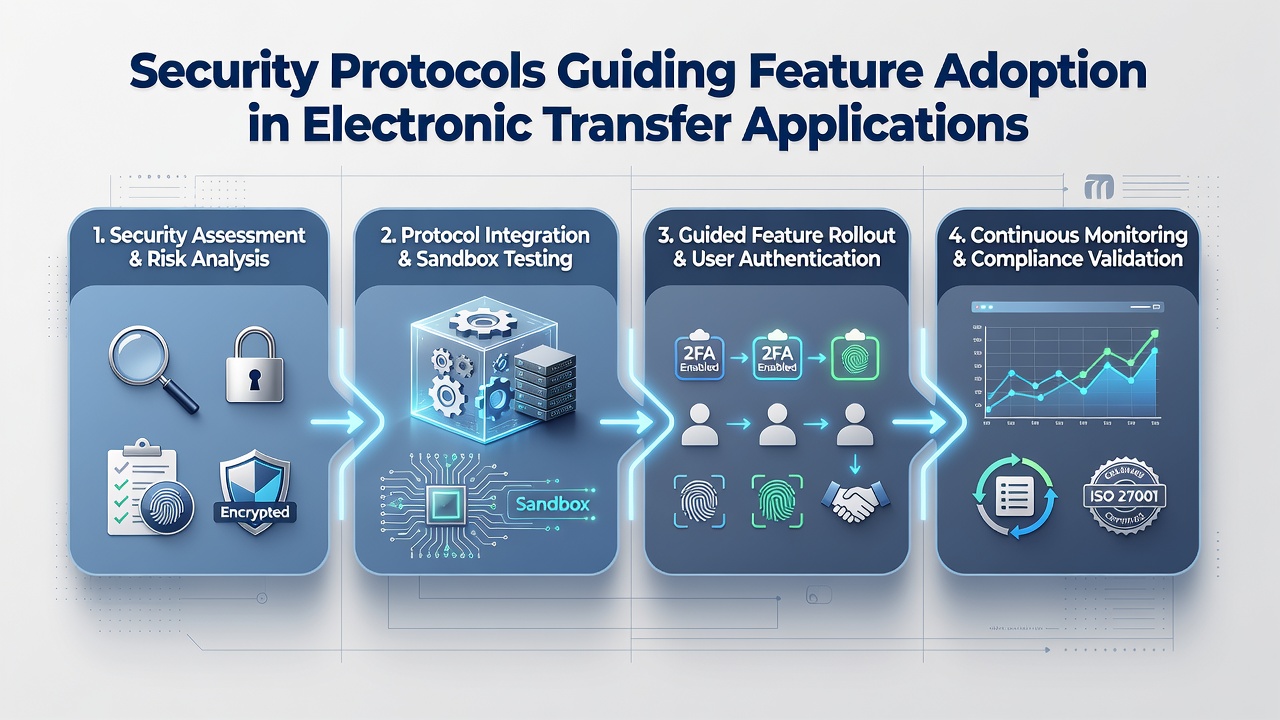
Security protocols form the backbone that determines which features gain approval for integration into electronic transfer applications, and those frameworks continue to evolve as transaction volumes grow across global networks. Developers must align new capabilities with established standards for encryption, authentication, and data integrity before deployment proceeds, while compliance teams review each addition against regulatory benchmarks that update periodically.
Core Protocols Shaping Feature Design
Encryption standards such as AES-256 and TLS 1.3 set baseline requirements that influence everything from real-time balance checks to multi-currency conversion tools. When teams propose a new feature like instant peer-to-peer splits, protocol reviews first verify whether the addition maintains end-to-end encryption throughout the data lifecycle. Authentication layers add another filter, requiring multi-factor methods that incorporate device binding and behavioral signals before any feature can activate for users. Observers note that applications adopting FIDO2 standards have integrated passwordless login options more rapidly because those protocols already satisfy many regional verification mandates.
Regulatory Benchmarks and Adoption Timelines
Regional frameworks create specific gates that features must pass. In the United States, NIST guidelines on cryptographic modules dictate how biometric verification tools receive certification, whereas the European Union's eIDAS regulation outlines mutual recognition rules that affect cross-border transfer features. Data shows that updates issued in June 2026 to certain payment service directives prompted several platforms to delay rollout of AI-driven fraud scoring until revised risk-assessment modules received approval. Those adjustments ensured continued alignment with evolving expectations around algorithmic transparency and audit trails.
Authentication Innovations Under Review
Biometric integration and behavioral analytics represent two areas where protocol compliance directly accelerates or restricts adoption. Systems that combine fingerprint recognition with continuous session monitoring often clear security audits faster because existing frameworks already address template storage and liveness detection. Research from academic groups indicates that applications incorporating these layered approaches have expanded their feature sets, including scheduled recurring transfers and merchant loyalty linkages, without triggering additional compliance delays. Yet any feature that stores or transmits location data alongside transaction details undergoes extra scrutiny under privacy protocols that vary by jurisdiction.
Encryption and Data Handling Requirements
Secure key management practices guide the introduction of features that involve shared accounts or delegated access. Protocols such as those defined by the Payment Card Industry Security Standards Council require that encryption keys rotate at defined intervals and remain isolated from application logic. When developers introduce capabilities like exportable transaction reports or integration with accounting software, those additions must preserve key isolation and support secure export formats. Figures from industry reports reveal that platforms maintaining strict key rotation schedules experience fewer interruptions when adding reporting dashboards or API endpoints for third-party services.
Case Examples of Protocol-Guided Rollouts
One platform introduced tokenized card storage after confirming that the feature satisfied both EMVCo specifications and local data residency rules. The rollout occurred in phases, beginning with test users who triggered additional logging requirements during the evaluation period. Another service expanded its support for recurring bill payments only after implementing protocol-mandated anomaly detection that flagged unusual patterns in real time. Observers note that these measured approaches reduced the frequency of post-launch adjustments and allowed teams to allocate resources toward further enhancements rather than remediation.
Impact on Emerging Capabilities
Quantum-resistant cryptography discussions have begun to influence long-term planning for features that rely on public-key infrastructure. Although widespread migration remains several years away, early protocol assessments already shape how applications structure their certificate management systems. Features involving machine-learning models for spending insights must also demonstrate that training data handling complies with encryption and access-control standards before production deployment. Those who've studied adoption patterns report that applications embedding compliance checkpoints early in the development cycle bring capabilities to market with fewer revisions.
Conclusion
Security protocols continue to serve as the primary filter that determines the pace and scope of feature adoption in electronic transfer applications. By embedding protocol reviews into development workflows, teams ensure that new capabilities meet encryption, authentication, and regulatory benchmarks from the outset. As standards receive periodic updates, including those referenced for June 2026, platforms that maintain flexible yet rigorous compliance processes position themselves to introduce enhancements while preserving transaction integrity across diverse user bases.